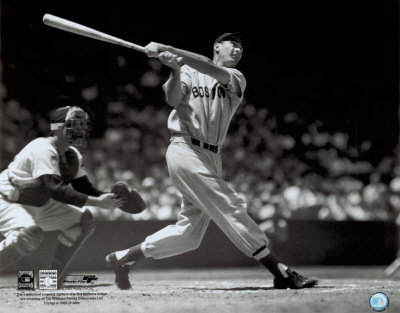
"The Kid"
Position:
Left Field
Right Field
Teams:
As a player:
Boston Red Sox (1939-1960)
As a manager:
Washington Senators/Texas Rangers (1969-1972)
Career Statistics:
Batting Average: .344
Home Runs: 521
RBI: 1,839
Slugging Percentage: .634
On-Base Percentage: .482
Hits: 2,654
Theodore Samuel Williams was born in San Diego, CA and grew up in the North Park neighborhood. He was taught how to throw a baseball when he was eight by his uncle, a former semi-pro baseball player. He attended and graduated from Herbert Hoover High School where he was a standout player, serving as a hitter-pitcher. While still in high school, he received offers from the St. Louis Cardinals and the New York Yankees. However, his mother felt he was still too young to leave home, so he signed with a minor league team named the San Diego Padres (Not the pro team. This team was a member of the Pacific Coast League).
While Ted initially served as a backup in the PCL, one of his teammates soon resigned to become head coach of the University of Georgia's football team. This opened a starting position up for Ted. In 1936, he managed a .271 batting average on 107 at-bats for the Padres. He finally caught the eye of Boston Red Sox general manager Eddie Collins while Collins was scouting teammates of Ted's. The Padres won the PCL title, with Ted batting .291 with 23 homers. In December 1937, a deal was struck that sent Ted to the Boston Red Sox while the Padres received $35,000, two major leaguers, and two other minor leaguers.
Williams made it about a week in major league spring training before being sent down to AA Minneapolis Millers. Former major league standout, Rogers Hornsby was the spring manager for the Millers, and gave Ted useful advice on hitting and the steps he needed to take to make it in the major leagues. This became a pattern for Ted, as he often hit up seasoned veterans for tips on how to improve his game.
Ted easily became the star of the team in Minneapolis. He once posted a twenty-two game hitting streak that last from Memorial Day to mid-June. Though the team as a whole put in a lackluster performance, Ted was a standout, batting .366 with 46 home runs, and 142 RBI, while receiving the American Association Triple Crown and coming in second place in the MVP voting.
The following year, Ted made his major league debut in right field. In his first game on April 20, 1939, Ted went 1-for-4 against the Yankees. In his first home series at Fenway Park, Williams hit a double, a home run, and a triple off Cotton Pippen. At the end of his rookie season, he finished with a .327 batting average, with 31 homers, and 145 RBI, as well as coming in fourth place in MVP voting.
In 1940, Ted's made a move to left field to give another player more time in right field. Though he batted .344, his power had diminished slightly from the previous year, with 23 home runs, and 113 RBI. He also angered many people in Boston by claiming that his salary was "peanuts" and that he hated the city of Boston. He also claimed that the only real fun he'd had in 1940 was getting the opportunity to pitch once during a blowout loss to Detroit.
In 1941, Ted broke his ankle during the second week of spring training, which forced the Red Sox to pinch hit him for the first two weeks of the season. By May 15, he had started a 22-game hitting streak. By the time the All-Star break had arrived, he was hitting .405 with 62 RBI and 16 homers. By late August, he was hitting .402. Though his average declined slightly by late September, Ted managed to rebound, hitting .406 with 37 homers and 120 RBI.
On December 7, 1941, Japan attacked Pearl Harbor. In January 1942, Williams was drafted into the military. Williams lobbied to be granted a Class 3-A deferrment because his parents had divorced in 1939, and Williams was his mother's only source of income. His request was granted, but public perception was very negative, causing some of Williams' sponsors to drop him as a spokesman. The conditions of the reclassification obliged Williams to join the military at the end of the season. During the 1942 season, Ted won the Triple Crown with a .356 average with 36 homers and 137 RBI. He came in second in the MVP voting.
At the end of the year Ted entered the military, while also playing ball in Chapel Hill, North Carolina during preflight training. He served as a flight instructor at Naval Air Station Pensacola. He was then sent to Pearl Harbot awaiting his orders to join the China fleet when the war ended. In January 1946, he was released from active duty, though he did remain in the reserves.
Afterwards, Ted made his one and only postseason appearance in the 1946 World Series. He managed only five singles in 25 at-bats, with only one RBI. The Sox lost to the Cardinals in seven games. Williams was nearly traded to the Yankees in 1947 for Joe DiMaggio, though the deal was later cancelled when the Red Sox learned that the Yanks demanded Yogi Berra be shipped to Boston as well. Many believed that Williams would have shone in Yankee Stadium as it was much more friendly to left-handed batters, such as Williams.
On May 1, 1952, Ted was recalled to active military duty to serve in the Korean War. Williams was unhappy being called back into service, but he felt it was his patriotic duty to serve his country, so he went without complaint. He ended up flying 39 missions before being pulled from flight status in June 1953 because of an inner ear infection which disqualified him from flying.
After returning to the Major Leagues, Ted broke his collarbone in 1954. Despite this, he ended up with the league's highest batting average at .345. In '57, he hit .388, and in '58, at the age of 40, incredibly led the league in average once again with .328. In Ted's final major league at-bat on September 28, 1960, he capped off his incredible career by hitting a home run.
Williams spent his entire career obsessed with the art of hitting a baseball. He often studied wind and air currents before games, studied pitchers and fielders, and spent much of his time in left field practicing his swing by watching his shadow on the ground. He also received criticism due to this obsession because he allowed it to interfere with his defensive abilities. Ted was a rather lackluster fielder, though he did possess a very powerful throwing arm. However, hitting was always at the top of Ted's priority list, which was evident by the incredible numbers he put up. He even released a book in 1970 called "The Science of Hitting."
After retirement, Ted became manager of the expansion Washington Senators, and remained in that capacity after they relocated to Texas and became the Rangers. His managerial record was fairly poor, with his best season being an 86-76 record in 1969. After this, Ted would sometimes visit Red Sox training camp and tutor young players on the art of hitting. Surprisingly, Ted entered into a successful career as a fly fisherman, being named to the International Game Fish Association Hall of Fame in 2000. He also began marketing and endorsing sports equipment for Sears.
During Ted's final years, he began to have heart problems. A pacemaker was installed in 2000 and he underwent open-heart surgery in 2001. After suffering several strokes and congestive heart failure, he died of cardiac arrest in Citrus Hills, FL on July 5, 2002 at the age of 83.
Total Pageviews
Friday, March 25, 2011
#7 - Lou Gehrig (1903-1941)
"The Iron Horse"
Position:
First Base
Teams:
New York Yankees (1923-1939)
Career Statistics:
Batting Average: .340
Home Runs: 493
RBI: 1,995
Slugging Percentage: .632
On-Base Percentage: .447
Hits: 2,721
Henry Louis Gehrig was born in Manhattan to German immigrants. He first attracted attention for his athletic abilities at Cubs Park (now Wrigley Field) on June 26, 1920. His team, New York School of Commerce, was playing Lane Tech High School of Chicago. In the top of the ninth inning, with his team ahead 8-6, Gehrig crushed a grand slam that completely left the major league park. He was 17 years old.
After graduating high school in 1921, Gehrig attended Columbia University for two years. Though he was unaware of it at the team, he had rendered himself ineligible to play baseball for the university because he had played for a professional summer league during his freshman year. He was, however, allowed to play football and became an exemplary fullback. He later regained his baseball eligibility and played that sport as well.
On April 18, 1923, Gehrig struck out seventeen hitters from Williams College, though his Columbia team ended up losing the game. Yankees scout, Paul Krichell attended this game, though he was more impressed with Gehrig's powerful swing than his pitching prowess. He had once hit a 450-foot home run at Columbia's South Field which ended up on 116th Street and Broadway. Two months later, Gehrig signed a contract to play with the New York Yankees.
He joined the Yanks midway through the 1923 season, debuting on June 15 as a pinch hitter. He remained primarily a pinch hitter for his first two seasons. He played in only 23 games and was not added to the 1923 World Series roster. In 1925, he batted .295 with 20 home runs and 68 RBI.
However, in 1926, Gehrig began to show his true potential. He batted .313 with 47 doubles, 20 triples, 16 homers, and 112 RBI. During the World Series that year, he pounded the St. Louis Cardinals, hitting .348 with two doubles, and four RBI. The Cardinals ended up winning the Series 4-3.
In 1927, Gehrig put up batting numbers that were some of the greatest in the history of the game. He batted .373 with 218 hits: 52 doubles, 18 triples, 47 homers, 175 RBI (a record, until Hack Wilson drove in 190 runs in 1930), and a .765 slugging percentage. His Yankees ended up defeating the Pittsburgh Pirates that year in the World Series. Gehrig was named MVP that season, though his accomplishment was overshadowed by Babe Ruth's (his teammate) record-setting 60 home runs. The Yankees lineup at this time is still considered one of the greatest ever, and is known by the sinister nickname "Murderer's Row."
Gehrig often found himself living in the shadow of the larger-than-life Babe Ruth, though the numbers he put up were beyond impressive. He had 509 RBI during a three-year stretch (1930-1932). Only Jimmie Foxx and Hank Greenberg have ever batted in over 500 runners over three seasons, though their accomplishments took place over non-consecutive seasons. He hit over .350 or better during six seasons, and seven seasons with 150 RBI or more, 11 seasons with over 100 walks, eight seasons with 200 or more hits, and five seasons with over 40 homers.
One of the major accomplishments Lou Gehrig is renowned for is his 2,130 consecutive games played (a record which Cal Ripken, Jr. broke on September 6, 1995), for which he was nicknamed "The Iron Horse." He played through pain and terrible injuries on many occasions, such as getting hit in the head by a Washington Senators pitcher and suffering through a terrible bout of back pain (which many believe may have been an early symptom of the disease which would later claim his life). Additionally, x-rays taken later in his life showed that every one of the fingers on each of his hands had been broken at some point during his playing career, injuries that he had continued to play through. On the other hand, Yankees general manager, Ed Barrow, once postponed a game because of rain, even though it was not raining, all because Gehrig had the flu and would not be able to compete.
Mid-way through the 1938 season, Gehrig reported some physical changes. He said, "I tired mid-season. I don't know why, but I just couldn't get going again." Though his stats from that season were still impressive, they had dropped considerably from 1937. When the Yanks began spring training in 1939, it was clear something was seriously wrong with Gehrig. His base running was affected, and at one point he collapsed at the Yankees spring training park. He did not hit a single home run the entire pre-season. By the end of April, his stats were the worst of his career, and it was obvious his coordination was off. He was only batting .143 with one RBI. He was still making contact with the ball, but his legendary power seemed to have disappeared seemingly overnight. On May 2, Gehrig approached manager Joe McCarthy and said that he was benching himself for the good of the team. He stayed with the Yankees as the team captain for the remainder of the season, but he would never play a major league game again.
As his symptoms becamse increasingly worse, Gehrig's wife contacted the Mayo Clinic and she was told to bring him in immediately. They arrived on June 13, 1939. After a rigorous battery of tests, Gehrig was diagnosed with amyotrophic lateral sclerosis (ALS), which causes rapidly progressing paralysis, as well as difficulty speaking and swallowing. The life expectancy was about three years.
The Yankees announced Gehrig's retirement on June 21 and proclaimed July 4 "Lou Gehrig Appreciation Day." Between games of the Yankees's double header against the Washington Senators, a ceremony was held for Lou Gehrig. Dignitaries and members of the 1927 Yankees World Championship Team (including Babe Ruth) attended. Gehrig's number "4" was retired by the Yankees, the first Major League Baseball player to ever be awarded such an honor. Footage of the ceremony shows many gifts being handed to Gehrig, though he had to immediately sit them down as he didn't have the arm strength to hold them. After tearful speeches by manager, Joe McCarthy and former teammate, Babe Ruth, Gehrig stepped up to the mike and delivered one of the most famous speeches in sports history:
"Fans, for the past two weeks you've been reading about the bad break I got. Yet today I consider myself the luckiest man on the face of the earth. I have been in ballparks for seventeen years and have never received anything but kindness and encouragement from you fans.
"Look at these grand men. Which of you wouldn't consider it the highlight of his career just to associate with them for even one day? Sure I'm lucky. Who wouldn't consider it an honor to have known Jacob Ruppert (owner of the Yankees)? Also, the builder of baseball's greatest empire, Ed Barrow (manager of the Yankees)? To have spent six years with that wonderful little fellow, Miller Huggins (teammate of Gehrig)? Then to have spent the next nine years with that outstanding leader, that smart student of psychology, the best manager in baseball today, Joe McCarthy? Sure, I'm lucky.
"When the New York Giants, a team you would give your right arm to beat, and vice versa, sends you a gift - that's something. When everybody down to the groundskeepers and those boys in white coats remember you with trophies - that's something. When you have a wonderful mother-in-law who takes sides with you in squabbles with her own daughter - that's something. When you have a father and mother who work all their lives so that you can have an education and build your body - it's a blessing. When you have a wife who has been a tower of strength and shown more courage than you dreamed existed - that's the finest I know.
"So I close in saying that I might have been given a bad break, but I've got an awful lot to live for. Thank you."
Lou Gehrig received a two minute standing ovation. Afterward, Babe Ruth came over and hugged him as the band played "I Love You Truly." Gehrig was unanimously elected to the Hall of Fame in 1939, at the age of 36.
In October 1939, Gehrig accepted Mayor Fiorello LaGuardia's offer of a ten-year term as New York City Parole Commissioner. As on the baseball field, Gehrig efficiently performed his duties. When official documents had to be signed, his wife guided his hand. About a month before his death, his condition had deteriorated to a point where he was forced to resign his position.
On June 2, 1941, two years after his retirement from baseball, Lou Gehrig died at his home in The Bronx.
Lou Gehrig (l) being embraced by former teammate Babe Ruth after his farewell ceremony.
Position:
First Base
Teams:
New York Yankees (1923-1939)
Career Statistics:
Batting Average: .340
Home Runs: 493
RBI: 1,995
Slugging Percentage: .632
On-Base Percentage: .447
Hits: 2,721
Henry Louis Gehrig was born in Manhattan to German immigrants. He first attracted attention for his athletic abilities at Cubs Park (now Wrigley Field) on June 26, 1920. His team, New York School of Commerce, was playing Lane Tech High School of Chicago. In the top of the ninth inning, with his team ahead 8-6, Gehrig crushed a grand slam that completely left the major league park. He was 17 years old.
After graduating high school in 1921, Gehrig attended Columbia University for two years. Though he was unaware of it at the team, he had rendered himself ineligible to play baseball for the university because he had played for a professional summer league during his freshman year. He was, however, allowed to play football and became an exemplary fullback. He later regained his baseball eligibility and played that sport as well.
On April 18, 1923, Gehrig struck out seventeen hitters from Williams College, though his Columbia team ended up losing the game. Yankees scout, Paul Krichell attended this game, though he was more impressed with Gehrig's powerful swing than his pitching prowess. He had once hit a 450-foot home run at Columbia's South Field which ended up on 116th Street and Broadway. Two months later, Gehrig signed a contract to play with the New York Yankees.
He joined the Yanks midway through the 1923 season, debuting on June 15 as a pinch hitter. He remained primarily a pinch hitter for his first two seasons. He played in only 23 games and was not added to the 1923 World Series roster. In 1925, he batted .295 with 20 home runs and 68 RBI.
However, in 1926, Gehrig began to show his true potential. He batted .313 with 47 doubles, 20 triples, 16 homers, and 112 RBI. During the World Series that year, he pounded the St. Louis Cardinals, hitting .348 with two doubles, and four RBI. The Cardinals ended up winning the Series 4-3.
In 1927, Gehrig put up batting numbers that were some of the greatest in the history of the game. He batted .373 with 218 hits: 52 doubles, 18 triples, 47 homers, 175 RBI (a record, until Hack Wilson drove in 190 runs in 1930), and a .765 slugging percentage. His Yankees ended up defeating the Pittsburgh Pirates that year in the World Series. Gehrig was named MVP that season, though his accomplishment was overshadowed by Babe Ruth's (his teammate) record-setting 60 home runs. The Yankees lineup at this time is still considered one of the greatest ever, and is known by the sinister nickname "Murderer's Row."
Gehrig often found himself living in the shadow of the larger-than-life Babe Ruth, though the numbers he put up were beyond impressive. He had 509 RBI during a three-year stretch (1930-1932). Only Jimmie Foxx and Hank Greenberg have ever batted in over 500 runners over three seasons, though their accomplishments took place over non-consecutive seasons. He hit over .350 or better during six seasons, and seven seasons with 150 RBI or more, 11 seasons with over 100 walks, eight seasons with 200 or more hits, and five seasons with over 40 homers.
One of the major accomplishments Lou Gehrig is renowned for is his 2,130 consecutive games played (a record which Cal Ripken, Jr. broke on September 6, 1995), for which he was nicknamed "The Iron Horse." He played through pain and terrible injuries on many occasions, such as getting hit in the head by a Washington Senators pitcher and suffering through a terrible bout of back pain (which many believe may have been an early symptom of the disease which would later claim his life). Additionally, x-rays taken later in his life showed that every one of the fingers on each of his hands had been broken at some point during his playing career, injuries that he had continued to play through. On the other hand, Yankees general manager, Ed Barrow, once postponed a game because of rain, even though it was not raining, all because Gehrig had the flu and would not be able to compete.
Mid-way through the 1938 season, Gehrig reported some physical changes. He said, "I tired mid-season. I don't know why, but I just couldn't get going again." Though his stats from that season were still impressive, they had dropped considerably from 1937. When the Yanks began spring training in 1939, it was clear something was seriously wrong with Gehrig. His base running was affected, and at one point he collapsed at the Yankees spring training park. He did not hit a single home run the entire pre-season. By the end of April, his stats were the worst of his career, and it was obvious his coordination was off. He was only batting .143 with one RBI. He was still making contact with the ball, but his legendary power seemed to have disappeared seemingly overnight. On May 2, Gehrig approached manager Joe McCarthy and said that he was benching himself for the good of the team. He stayed with the Yankees as the team captain for the remainder of the season, but he would never play a major league game again.
As his symptoms becamse increasingly worse, Gehrig's wife contacted the Mayo Clinic and she was told to bring him in immediately. They arrived on June 13, 1939. After a rigorous battery of tests, Gehrig was diagnosed with amyotrophic lateral sclerosis (ALS), which causes rapidly progressing paralysis, as well as difficulty speaking and swallowing. The life expectancy was about three years.
The Yankees announced Gehrig's retirement on June 21 and proclaimed July 4 "Lou Gehrig Appreciation Day." Between games of the Yankees's double header against the Washington Senators, a ceremony was held for Lou Gehrig. Dignitaries and members of the 1927 Yankees World Championship Team (including Babe Ruth) attended. Gehrig's number "4" was retired by the Yankees, the first Major League Baseball player to ever be awarded such an honor. Footage of the ceremony shows many gifts being handed to Gehrig, though he had to immediately sit them down as he didn't have the arm strength to hold them. After tearful speeches by manager, Joe McCarthy and former teammate, Babe Ruth, Gehrig stepped up to the mike and delivered one of the most famous speeches in sports history:
"Fans, for the past two weeks you've been reading about the bad break I got. Yet today I consider myself the luckiest man on the face of the earth. I have been in ballparks for seventeen years and have never received anything but kindness and encouragement from you fans.
"Look at these grand men. Which of you wouldn't consider it the highlight of his career just to associate with them for even one day? Sure I'm lucky. Who wouldn't consider it an honor to have known Jacob Ruppert (owner of the Yankees)? Also, the builder of baseball's greatest empire, Ed Barrow (manager of the Yankees)? To have spent six years with that wonderful little fellow, Miller Huggins (teammate of Gehrig)? Then to have spent the next nine years with that outstanding leader, that smart student of psychology, the best manager in baseball today, Joe McCarthy? Sure, I'm lucky.
"When the New York Giants, a team you would give your right arm to beat, and vice versa, sends you a gift - that's something. When everybody down to the groundskeepers and those boys in white coats remember you with trophies - that's something. When you have a wonderful mother-in-law who takes sides with you in squabbles with her own daughter - that's something. When you have a father and mother who work all their lives so that you can have an education and build your body - it's a blessing. When you have a wife who has been a tower of strength and shown more courage than you dreamed existed - that's the finest I know.
"So I close in saying that I might have been given a bad break, but I've got an awful lot to live for. Thank you."
Lou Gehrig received a two minute standing ovation. Afterward, Babe Ruth came over and hugged him as the band played "I Love You Truly." Gehrig was unanimously elected to the Hall of Fame in 1939, at the age of 36.
In October 1939, Gehrig accepted Mayor Fiorello LaGuardia's offer of a ten-year term as New York City Parole Commissioner. As on the baseball field, Gehrig efficiently performed his duties. When official documents had to be signed, his wife guided his hand. About a month before his death, his condition had deteriorated to a point where he was forced to resign his position.
On June 2, 1941, two years after his retirement from baseball, Lou Gehrig died at his home in The Bronx.
Lou Gehrig (l) being embraced by former teammate Babe Ruth after his farewell ceremony.
#8 - Mickey Mantle (1931-1995)
"The Mick" "The Commerce Comet"
Position:
Center Field
Right Field
Left Field
First Base
Teams:
New York Yankees (1951-1968)
Career Statistics:
Batting Average: .298
Home Runs: 536
RBI: 1,509
Slugging Percentage: .557
On-Base Percentage: .421
Hits: 2,415
Mickey Charles Mantle was born in Spavinaw, Oklahoma on October 20, 1931. When he was four years old, his family moved to Commerce, Oklahoma, where Mantle later went on to be a star athlete at Commerce High School playing baseball, basketball, and football. It was while playing football that Mantle sustained an injury that nearly derailed his athletic career before it even had a chance to take off. During a game, Mick was kicked in the shin and his leg became infected with osteomyelitis, an infection of the bone. However, thanks to the newly available penicillin, his leg was saved from amputation. Unfortunatley, the disease's effects plagued him for the rest of his life, and likely contributed to many of the injuries that hampered his playing career. It also caused him to be exempt from military service, which alienated some fans, though Mantle claimed that he would have gladly served if he'd been allowed to do so.
Mantle initially played for a semi-pro team called the Baxter Spring, Kansas Whiz Kids. In 1948, a Yankees scout named Tom Greenwade traveled to Baxter Springs to check out Mantle's teammate, third baseman Billy Johnson. He saw Mantle switch-hit two home runs into the river running behind the ballpark. Greenwade stated that Mantle was the best prospect he had ever seen, but since Mantle was only sixteen, he had to wait until his high school graduation to sign him. He then signed a minor league contract with the Yankees's class-D affiliate in Independence, Kansas.
Mantle was called up to the majors on April 7, 1951 to play right field. But after a brief slump, he was sent back down to the Kansas City Blues, the Yankees's top farm team. He found that the power he had exhibited in the lower minors had temporarily abandoned him. Frustrated, he contacted his father and said that he didn't think he would be able to play anymore. His father drove all the way to Kansas City and began packing Mantle's bag for him, saying "I thought I raised a man. I see I raised a coward, instead. You can come back to Oklahoma and work the mines with me." Mantle quickly broke out of his slump, hitting .361 with 11 homers and 50 RBI. He was called back to New York permanently after forty games.
Mick played in his first World Series that year against Willie Mays and the San Francisco Giants. During the series, Mays hit a drive to deep right center. Mantle and Joe DiMaggio (in his final season) both converged on the ball. DiMaggio called for the catch at the last second, causing Mantle to stop short. His cleat caught a drainage cover hidden in the outfield grass. His knee twisted awkwardly and he fell to the ground. Some speculate that he may have torn his ACL, but there was no surgical repair technique available at the time, so it's possible he may have played the rest of his career suffering from the damage that had been done. Mantle was forced to watch the rest of the World Series (which the Yankees won 4-2) from a hospital bed.
Like Ken Griffey, Jr. much of Mantle's career was hampered by nagging questions of "what if?" Due to his propensity for injury, Mantle missed out on a lot of valuable playing time and was often forced to play in considerable pain.
Mantle moved to the center field position starting in 1952 after Joe DiMaggio's retirement. This is where he would remain for much of his career.
Mick was also known for some of the monster home runs that he hit during his career. On September 10, 1960, he crushed a ball that cleared the right field roof in Tigers Stadium. It was estimated that this ball may have traveled some 643 feet. Another ball, hit at Griffith Stadium in Washington, D.C. was measure at 565 feet. On May 22, 1963, he hit a ball that struck the 110-foot tall facade in Yankee Stadium before bouncing back onto the field. Many fans and teammates claim that the ball was still rising when it hit. There has been much debate about the distances these shots traveled, as the ball was often measured where it lay as opposed to where it originally hit, meaning that the ball often bounced considerable distances after landing. However, there is no doubt that many of these homers exceeded 500 feet.
In 1956, Mickey Mantle won the Triple Crown, leading the majors with a .353 batting average, 52 homers, and 130 RBI. In 1957, Mantle led the league in runs and walks, while batting a career-high .365, second only to Ted Williams's .388. Mantle also reached base more times than he recorded outs (319 to 312), which he managed to do twice in his career.
During the historic 1961 season, Mantle and teammate Roger Maris engaged in a (friendly) battle to topple Babe Ruth's 34 year record for most home runs in a season (Ruth hit 60). Mantle had challenged the record in 1956, but the press and fans in New York were not too eager to see their precious Babe's record broken by a hick from Oklahoma. He finished the '56 season with 52 homers. However, in the '61 season, New York embraced Mantle and shunned the sometimes-surly Maris. Mantle was forced to drop out of the race late in the season because of an abcessed hip, which allowed Maris to break the record with 61 homers.
Mantle was hampered by injuries in the 1965 season, hitting only .255 with 19 homers. After the 1966 season, he was moved to first base for the remainder of his career. His last home run came on September 20, 1968.
Mantle retired in his 1969 and was inducted in the Hall of Fame in 1974, his first years of eligibility. He served part-time as a color commentator for NBC and then worked at Claridge Resort and Casino in Atlantic City as a greeter and community representative.
Mick battled with alcoholism for much of his life, rationalizing it by saying that all of the men in his family had died young, so he might as well live it up while he was still here. His father died in 1952 at the age of 39 of Hodgkin's Lymphoma, a disease which his grandfather also succumbed to. Unbeknownst to Mantle, their diseases were most likely caused by inhaling lead and zinc while working in the mines in Oklahoma. In 1994, Mantle checked into the Betty Ford Clinic, where the doctors informed him that his liver was so badly damaged, that he could die at any time. It was also discovered that he was suffering from inoperable liver cancer. On June 8, 1995, Mantle received a liver transplant at Baylor University Medical Center. During a press conference after the surgery, Mantle acknowledged that many fans looked at him as a role model. He stated, "This is a role model: Don't be like me." He was soon back in the hospital, as it was discovered that the cancer had spread throughout his body.
On August 13, 1995, Mantle passed away at Baylor University Medical Center.
Position:
Center Field
Right Field
Left Field
First Base
Teams:
New York Yankees (1951-1968)
Career Statistics:
Batting Average: .298
Home Runs: 536
RBI: 1,509
Slugging Percentage: .557
On-Base Percentage: .421
Hits: 2,415
Mickey Charles Mantle was born in Spavinaw, Oklahoma on October 20, 1931. When he was four years old, his family moved to Commerce, Oklahoma, where Mantle later went on to be a star athlete at Commerce High School playing baseball, basketball, and football. It was while playing football that Mantle sustained an injury that nearly derailed his athletic career before it even had a chance to take off. During a game, Mick was kicked in the shin and his leg became infected with osteomyelitis, an infection of the bone. However, thanks to the newly available penicillin, his leg was saved from amputation. Unfortunatley, the disease's effects plagued him for the rest of his life, and likely contributed to many of the injuries that hampered his playing career. It also caused him to be exempt from military service, which alienated some fans, though Mantle claimed that he would have gladly served if he'd been allowed to do so.
Mantle initially played for a semi-pro team called the Baxter Spring, Kansas Whiz Kids. In 1948, a Yankees scout named Tom Greenwade traveled to Baxter Springs to check out Mantle's teammate, third baseman Billy Johnson. He saw Mantle switch-hit two home runs into the river running behind the ballpark. Greenwade stated that Mantle was the best prospect he had ever seen, but since Mantle was only sixteen, he had to wait until his high school graduation to sign him. He then signed a minor league contract with the Yankees's class-D affiliate in Independence, Kansas.
Mantle was called up to the majors on April 7, 1951 to play right field. But after a brief slump, he was sent back down to the Kansas City Blues, the Yankees's top farm team. He found that the power he had exhibited in the lower minors had temporarily abandoned him. Frustrated, he contacted his father and said that he didn't think he would be able to play anymore. His father drove all the way to Kansas City and began packing Mantle's bag for him, saying "I thought I raised a man. I see I raised a coward, instead. You can come back to Oklahoma and work the mines with me." Mantle quickly broke out of his slump, hitting .361 with 11 homers and 50 RBI. He was called back to New York permanently after forty games.
Mick played in his first World Series that year against Willie Mays and the San Francisco Giants. During the series, Mays hit a drive to deep right center. Mantle and Joe DiMaggio (in his final season) both converged on the ball. DiMaggio called for the catch at the last second, causing Mantle to stop short. His cleat caught a drainage cover hidden in the outfield grass. His knee twisted awkwardly and he fell to the ground. Some speculate that he may have torn his ACL, but there was no surgical repair technique available at the time, so it's possible he may have played the rest of his career suffering from the damage that had been done. Mantle was forced to watch the rest of the World Series (which the Yankees won 4-2) from a hospital bed.
Like Ken Griffey, Jr. much of Mantle's career was hampered by nagging questions of "what if?" Due to his propensity for injury, Mantle missed out on a lot of valuable playing time and was often forced to play in considerable pain.
Mantle moved to the center field position starting in 1952 after Joe DiMaggio's retirement. This is where he would remain for much of his career.
Mick was also known for some of the monster home runs that he hit during his career. On September 10, 1960, he crushed a ball that cleared the right field roof in Tigers Stadium. It was estimated that this ball may have traveled some 643 feet. Another ball, hit at Griffith Stadium in Washington, D.C. was measure at 565 feet. On May 22, 1963, he hit a ball that struck the 110-foot tall facade in Yankee Stadium before bouncing back onto the field. Many fans and teammates claim that the ball was still rising when it hit. There has been much debate about the distances these shots traveled, as the ball was often measured where it lay as opposed to where it originally hit, meaning that the ball often bounced considerable distances after landing. However, there is no doubt that many of these homers exceeded 500 feet.
In 1956, Mickey Mantle won the Triple Crown, leading the majors with a .353 batting average, 52 homers, and 130 RBI. In 1957, Mantle led the league in runs and walks, while batting a career-high .365, second only to Ted Williams's .388. Mantle also reached base more times than he recorded outs (319 to 312), which he managed to do twice in his career.
During the historic 1961 season, Mantle and teammate Roger Maris engaged in a (friendly) battle to topple Babe Ruth's 34 year record for most home runs in a season (Ruth hit 60). Mantle had challenged the record in 1956, but the press and fans in New York were not too eager to see their precious Babe's record broken by a hick from Oklahoma. He finished the '56 season with 52 homers. However, in the '61 season, New York embraced Mantle and shunned the sometimes-surly Maris. Mantle was forced to drop out of the race late in the season because of an abcessed hip, which allowed Maris to break the record with 61 homers.
Mantle was hampered by injuries in the 1965 season, hitting only .255 with 19 homers. After the 1966 season, he was moved to first base for the remainder of his career. His last home run came on September 20, 1968.
Mantle retired in his 1969 and was inducted in the Hall of Fame in 1974, his first years of eligibility. He served part-time as a color commentator for NBC and then worked at Claridge Resort and Casino in Atlantic City as a greeter and community representative.
Mick battled with alcoholism for much of his life, rationalizing it by saying that all of the men in his family had died young, so he might as well live it up while he was still here. His father died in 1952 at the age of 39 of Hodgkin's Lymphoma, a disease which his grandfather also succumbed to. Unbeknownst to Mantle, their diseases were most likely caused by inhaling lead and zinc while working in the mines in Oklahoma. In 1994, Mantle checked into the Betty Ford Clinic, where the doctors informed him that his liver was so badly damaged, that he could die at any time. It was also discovered that he was suffering from inoperable liver cancer. On June 8, 1995, Mantle received a liver transplant at Baylor University Medical Center. During a press conference after the surgery, Mantle acknowledged that many fans looked at him as a role model. He stated, "This is a role model: Don't be like me." He was soon back in the hospital, as it was discovered that the cancer had spread throughout his body.
On August 13, 1995, Mantle passed away at Baylor University Medical Center.
Monday, March 21, 2011
#9 - Joe DiMaggio (1914-1999)
"Joltin' Joe" "The Yankee Clipper"
Position:
Center Field
Teams:
New York Yankees (1936-1942; 1946-1951)
Career Statistics:
Batting Average: .325
Home Runs: 361
RBI: 1,537
Slugging Percentage: .579
On-Base Percentage: .398
Hits: 2,214
Joseph Paul DiMaggio was born in Martinez, California to Italian immigrant parents, Giuseppe and Rosalia DiMaggio. Giuseppe had aspirations that his son (as well as his other eight children) would become fishermen like himself. Joe, however, had no interest in this pursuit, stating that the smell of fish nauseated him. He turned to baseball instead.
He was already playing semi-pro baseball when his brother, Vince (who was playing for the San Francisco Seals of the Pacific Coast League) convinced his manager to allow Joe to fill in at shortstop. On October 1, 1932, Joe DiMaggio made his professional debut. From May 27-July 25, 1933, Joe logged a 61-game hitting streak, which at the time was a PCL record.
Though he suffered torn ligaments in his knee due to an accident, the New York Yankees decided to buy his contract on November 21, 1934 for $25,000 and five players, though the Seals got to hang onto him for the 1935 season. In his final season in the PCL, he batted .398 with 154 RBI, and 34 home runs, leading his team to the league championship and gaining the most valuable player award for himself.
DiMaggio made his major league debut on May 3, 1936. Prior to adding DiMaggio, the Yankees had not been to the World Series since 1932. They won the next four. He would eventually lead the Yankees to nine titles in 13 years.
In 1936, he managed to hit 44 doubles and 15 triples, drove in 125 runs, and hit 29 homers. This was even after missing 16 games due to injury. In 1937, he collected 418 total bases in one season. The only other players who have topped this achievenment are Babe Ruth (who holds the record with 457 total bases in 1921), Stan Musial (429 in 1948), Sammy Sosa (425 in 2001), and Luis Gonzalez (419 in 2001). During this sophomore season, his stats were astounding. He drove in 167 runs and scored 151, as well as hitting 46 homers.
One of the most amazing aspects of Joe DiMaggio's career is the incredibly low number of times he struck out. During his rookie season, he hit 29 home runs, but only struck out 39 times. The following season, he hit nine more homers than strike-outs. For comparison, Reggie Jackson struck out 2,597 times in his career (the major league record). Over one-hundred players have struck out more than 1,200 times in their careers. Even players who are lauded for their careful eyes at the plate (Barry Bonds and Ted Williams come to mind) struck out more than Joe DiMaggio. Joltin' Joe struck out a grand total of 369 times in a 13-year career. Sammy Sosa struck out 345 times in just two seasons.
Perhaps the most famous thing Joe DiMaggio is known for (besides being married to Marilyn Monroe) was his epic 56-game hitting streak in 1941. The second longest hitting streak that any player has ever had was 44 games by Willie Keeler in 1896-1897. Pete Rose also hit safely in 44 straight games in 1978. After Joe's hit streak ended, he began another streak that lasted 16 games. During the course of these 56 games, he hit 56 singles, 16 doubles, 4 triples, and 15 homers, while scoring 55 runs.
DiMaggio won his first MVP award in 1939. In 1941, he beat out Ted Williams in a hotly contested race for the MVP award. In 1947, DiMaggio once again prevailed over Williams for the award, though many believe that Ted, in fact, deserved it this time.
Like Ted Williams, Joe DiMaggio lost time in his career to military service during World War II. He enlisted in the United States Army Air Forces in 1943 and eventually gained the rank of sergeant. He was stationed in California, Hawaii, and New Jersey as a physical education instructor before being discharged in 1945.
Chronic heel problems plagued Joe for much of his career and they eventually lead to his retirement in 1951, at the age of 37. In announcing his retirement, Joe stated " I feel like I have reached the stage where I can no longer produce for my club, my manager, and my teammates. I had a poor year, but even if I had hit .350, this would have been my last year. I was full of aches and pains and it had become a chore for me to play. When baseball is no longer fun, it's no longer a game, and so, I've played my last game."
During the 1970's, Joe kept himself busy during retirement by becoming a spokesman for Mr. Coffee, as well as the Bowery Savings Bank. A heavy smoker most of his adult life, Joe eventually contracted lung cancer. He was admitted to Memorial Regional Hospital in Hollywood, Florida on October 12, 1998 for lung cancer surgery. He eventually returned to his home and died January 19, 1999.
"Where have you gone Joe DiMaggio? A nation turns its lonely eyes to you. What's that you say, Mrs. Robinson? Joltin' Joe has left and gone away." - Simon and Garfunkel
Position:
Center Field
Teams:
New York Yankees (1936-1942; 1946-1951)
Career Statistics:
Batting Average: .325
Home Runs: 361
RBI: 1,537
Slugging Percentage: .579
On-Base Percentage: .398
Hits: 2,214
Joseph Paul DiMaggio was born in Martinez, California to Italian immigrant parents, Giuseppe and Rosalia DiMaggio. Giuseppe had aspirations that his son (as well as his other eight children) would become fishermen like himself. Joe, however, had no interest in this pursuit, stating that the smell of fish nauseated him. He turned to baseball instead.
He was already playing semi-pro baseball when his brother, Vince (who was playing for the San Francisco Seals of the Pacific Coast League) convinced his manager to allow Joe to fill in at shortstop. On October 1, 1932, Joe DiMaggio made his professional debut. From May 27-July 25, 1933, Joe logged a 61-game hitting streak, which at the time was a PCL record.
Though he suffered torn ligaments in his knee due to an accident, the New York Yankees decided to buy his contract on November 21, 1934 for $25,000 and five players, though the Seals got to hang onto him for the 1935 season. In his final season in the PCL, he batted .398 with 154 RBI, and 34 home runs, leading his team to the league championship and gaining the most valuable player award for himself.
DiMaggio made his major league debut on May 3, 1936. Prior to adding DiMaggio, the Yankees had not been to the World Series since 1932. They won the next four. He would eventually lead the Yankees to nine titles in 13 years.
In 1936, he managed to hit 44 doubles and 15 triples, drove in 125 runs, and hit 29 homers. This was even after missing 16 games due to injury. In 1937, he collected 418 total bases in one season. The only other players who have topped this achievenment are Babe Ruth (who holds the record with 457 total bases in 1921), Stan Musial (429 in 1948), Sammy Sosa (425 in 2001), and Luis Gonzalez (419 in 2001). During this sophomore season, his stats were astounding. He drove in 167 runs and scored 151, as well as hitting 46 homers.
One of the most amazing aspects of Joe DiMaggio's career is the incredibly low number of times he struck out. During his rookie season, he hit 29 home runs, but only struck out 39 times. The following season, he hit nine more homers than strike-outs. For comparison, Reggie Jackson struck out 2,597 times in his career (the major league record). Over one-hundred players have struck out more than 1,200 times in their careers. Even players who are lauded for their careful eyes at the plate (Barry Bonds and Ted Williams come to mind) struck out more than Joe DiMaggio. Joltin' Joe struck out a grand total of 369 times in a 13-year career. Sammy Sosa struck out 345 times in just two seasons.
Perhaps the most famous thing Joe DiMaggio is known for (besides being married to Marilyn Monroe) was his epic 56-game hitting streak in 1941. The second longest hitting streak that any player has ever had was 44 games by Willie Keeler in 1896-1897. Pete Rose also hit safely in 44 straight games in 1978. After Joe's hit streak ended, he began another streak that lasted 16 games. During the course of these 56 games, he hit 56 singles, 16 doubles, 4 triples, and 15 homers, while scoring 55 runs.
DiMaggio won his first MVP award in 1939. In 1941, he beat out Ted Williams in a hotly contested race for the MVP award. In 1947, DiMaggio once again prevailed over Williams for the award, though many believe that Ted, in fact, deserved it this time.
Like Ted Williams, Joe DiMaggio lost time in his career to military service during World War II. He enlisted in the United States Army Air Forces in 1943 and eventually gained the rank of sergeant. He was stationed in California, Hawaii, and New Jersey as a physical education instructor before being discharged in 1945.
Chronic heel problems plagued Joe for much of his career and they eventually lead to his retirement in 1951, at the age of 37. In announcing his retirement, Joe stated " I feel like I have reached the stage where I can no longer produce for my club, my manager, and my teammates. I had a poor year, but even if I had hit .350, this would have been my last year. I was full of aches and pains and it had become a chore for me to play. When baseball is no longer fun, it's no longer a game, and so, I've played my last game."
During the 1970's, Joe kept himself busy during retirement by becoming a spokesman for Mr. Coffee, as well as the Bowery Savings Bank. A heavy smoker most of his adult life, Joe eventually contracted lung cancer. He was admitted to Memorial Regional Hospital in Hollywood, Florida on October 12, 1998 for lung cancer surgery. He eventually returned to his home and died January 19, 1999.
"Where have you gone Joe DiMaggio? A nation turns its lonely eyes to you. What's that you say, Mrs. Robinson? Joltin' Joe has left and gone away." - Simon and Garfunkel
#10 - Alex Rodriguez (1975- )
"A-Rod"
Position:
Short Stop
Third Base
Teams:
Seattle Mariners (1994-2000)
Texas Rangers (2001-2003)
New York Yankees (2004-present)
Career Statistics:
Batting Average: .303
Home Runs: 613
Runs Batted In (RBI): 1,831
Slugging Percentage: .571
On-Base Percentage: .387
Hits: 2,672
Alex Rodriguez was drafted with the first overall pick by the Seattle Mariners in 1993 and was immediately sent to play for Seattle's AAA affiliate, the Calgary Cannons. During the course of the 32 games he spent with the ball club, he compiled 37 hits in 119 at-bats, for an average of .311. He also managed 6 homers with 21 RBI. He quickly rose through the ranks and finally made his major league debut at short stop for the Mariners on July 8, 1994. He was aged 18 years, 11 months, and 11 days. Regrettably, his rookie season was cut short by the 1994 Major League Baseball Strike.
The following season, he traded much of his time between the Mariners and their AAA club, the Tacoma Rainiers.
In 1996, however, he blasted 36 home runs, drove in 123 runs, and achieved a batting average of .358, which was the highest for an American League right-handed batter since Joe DiMaggio hit .381 in 1939. This was also the third highest average ever for a short-stop. He also lead the American League in runs (141), total bases (379), and doubles (54), while coming in second in hits (215), extra base hits (91), third in multi-hit games (65), fourth in slugging percentage (.631), eighth in RBI (123), and eighth in on-base percentage (.414). He came in second place in a hotly contested MVP race that year, which was eventually awarded to Juan Gonzalez. By the time A-Rod left the Mariners after the 2000 season, he had a batting average of .309 while hitting 189 homers, driving in 595 runs, and scoring 627 runs.
Rodriguez became a free agent after the 2000 season and eventually signed with the Texas Rangers in what was, at the time, the most lucrative deal in sports history: a 10 year deal worth $252 million. In his first season with the Rangers, he lead the American League with 52 home runs, 133 runs scored, and 393 total bases. He became the first player since 1932 with 50 homers and 200 hits in a season. He followed this phenomenal season with an even more impressive one in 2003: 57 home runs, 142 RBI, and 389 total bases, while also winning his first Gold Glove Award. In 2003, his last season with Texas, he finally won the American League MVP award.
Wanting to offload the enormous cost of keeping A-Rod aboard, the Texas Rangers agreed to trade him to the Boston Red Sox, but the trade was blocked by the Major League Baseball Players Association, who vetoed the deal because it meant a cut in salary for Rodriguez. So on February 15, 2004 the Rangers traded A-Rod to the New York Yankees for second baseman, Alfonso Soriano and a player to be named later (Joaquin Arias). In addition, the Rangers agreed to pay $67 million out of the $179 million left on Rodriguez's contract. This trade also necessitated a move to third base for A-Rod, as the short stop position was already filled by superstar, Derek Jeter.
In his first season as a Yankee, Rodriguez hit .286 with 36 home runs, 106 RBI, 112 runs scored, and 28 stolen bases. In 2005, Rodriguez hit .321, leading the American League with 124 runs scored, and 48 home runs, while driving in 130 runs. He became only the fifth player to ever win an MVP award with two different teams. He won the MVP award yet again in 2007, with 54 homers, 156 RBI, a .645 slugging percentage, 1.067 OPS (on-base plus slugging), 376 total bases, 299 times on base, 85 extra base hits, .422 OBP, and 95 walks. Also in 2007, A-Rod signed a 10-year, $275 million contract with the Yankees, which would have him playing until he is 42 years old.
In 2009, Rodriguez finally won a World Series ring, beating the Philadelphia Phillies seven games to four. A-Rod batted .365 and hit 6 home runs during the Yankees's 15 game post-season. In 2010, A-Rod became the seventh player in major league history to hit 600 home runs, while also being the youngest to do so at 35 years and 8 days old. On September 29, 2010, he hit his 30th home run of the season, which set a record with 13 straight years of at least 30 home runs and 100 RBI.
After years of denial, Alex Rodriguez finally admitted to using steroids while he was a member of the Texas Rangers, citing "an enormous amount of pressure to perform" during an interview on ESPN. He insists that he has been clean all the years that he has been playing in New York. Again the question has to be asked; Does steroid use nullify all of a player's achievements? I don't believe so. While steroid usage can provide enormous gains in muscle growth, many of the players who have used or been accused of using, did not enjoy the tremendous success of A-Rod or Barry Bonds. Steroids provide one with assistance in strength and muscle growth, not talent. This obviously must lead one to the conclusion that these players possess exceptional talent and made terrible errors in judgment while trying to compliment that talent. While A-Rod may not have put up the same numbers had he not been using steroids, I feel confident that his numbers would still remain incredibly impressive. And if he speaks the truth, and has not used steroids since becoming a member of the Yankees, it makes his numbers all the more astounding. And until a positive drug test comes back that shows his talents are being chemically supplemented, what other choice do I have then to place him at number ten?
Position:
Short Stop
Third Base
Teams:
Seattle Mariners (1994-2000)
Texas Rangers (2001-2003)
New York Yankees (2004-present)
Career Statistics:
Batting Average: .303
Home Runs: 613
Runs Batted In (RBI): 1,831
Slugging Percentage: .571
On-Base Percentage: .387
Hits: 2,672
Alex Rodriguez was drafted with the first overall pick by the Seattle Mariners in 1993 and was immediately sent to play for Seattle's AAA affiliate, the Calgary Cannons. During the course of the 32 games he spent with the ball club, he compiled 37 hits in 119 at-bats, for an average of .311. He also managed 6 homers with 21 RBI. He quickly rose through the ranks and finally made his major league debut at short stop for the Mariners on July 8, 1994. He was aged 18 years, 11 months, and 11 days. Regrettably, his rookie season was cut short by the 1994 Major League Baseball Strike.
The following season, he traded much of his time between the Mariners and their AAA club, the Tacoma Rainiers.
In 1996, however, he blasted 36 home runs, drove in 123 runs, and achieved a batting average of .358, which was the highest for an American League right-handed batter since Joe DiMaggio hit .381 in 1939. This was also the third highest average ever for a short-stop. He also lead the American League in runs (141), total bases (379), and doubles (54), while coming in second in hits (215), extra base hits (91), third in multi-hit games (65), fourth in slugging percentage (.631), eighth in RBI (123), and eighth in on-base percentage (.414). He came in second place in a hotly contested MVP race that year, which was eventually awarded to Juan Gonzalez. By the time A-Rod left the Mariners after the 2000 season, he had a batting average of .309 while hitting 189 homers, driving in 595 runs, and scoring 627 runs.
Rodriguez became a free agent after the 2000 season and eventually signed with the Texas Rangers in what was, at the time, the most lucrative deal in sports history: a 10 year deal worth $252 million. In his first season with the Rangers, he lead the American League with 52 home runs, 133 runs scored, and 393 total bases. He became the first player since 1932 with 50 homers and 200 hits in a season. He followed this phenomenal season with an even more impressive one in 2003: 57 home runs, 142 RBI, and 389 total bases, while also winning his first Gold Glove Award. In 2003, his last season with Texas, he finally won the American League MVP award.
Wanting to offload the enormous cost of keeping A-Rod aboard, the Texas Rangers agreed to trade him to the Boston Red Sox, but the trade was blocked by the Major League Baseball Players Association, who vetoed the deal because it meant a cut in salary for Rodriguez. So on February 15, 2004 the Rangers traded A-Rod to the New York Yankees for second baseman, Alfonso Soriano and a player to be named later (Joaquin Arias). In addition, the Rangers agreed to pay $67 million out of the $179 million left on Rodriguez's contract. This trade also necessitated a move to third base for A-Rod, as the short stop position was already filled by superstar, Derek Jeter.
In his first season as a Yankee, Rodriguez hit .286 with 36 home runs, 106 RBI, 112 runs scored, and 28 stolen bases. In 2005, Rodriguez hit .321, leading the American League with 124 runs scored, and 48 home runs, while driving in 130 runs. He became only the fifth player to ever win an MVP award with two different teams. He won the MVP award yet again in 2007, with 54 homers, 156 RBI, a .645 slugging percentage, 1.067 OPS (on-base plus slugging), 376 total bases, 299 times on base, 85 extra base hits, .422 OBP, and 95 walks. Also in 2007, A-Rod signed a 10-year, $275 million contract with the Yankees, which would have him playing until he is 42 years old.
In 2009, Rodriguez finally won a World Series ring, beating the Philadelphia Phillies seven games to four. A-Rod batted .365 and hit 6 home runs during the Yankees's 15 game post-season. In 2010, A-Rod became the seventh player in major league history to hit 600 home runs, while also being the youngest to do so at 35 years and 8 days old. On September 29, 2010, he hit his 30th home run of the season, which set a record with 13 straight years of at least 30 home runs and 100 RBI.
After years of denial, Alex Rodriguez finally admitted to using steroids while he was a member of the Texas Rangers, citing "an enormous amount of pressure to perform" during an interview on ESPN. He insists that he has been clean all the years that he has been playing in New York. Again the question has to be asked; Does steroid use nullify all of a player's achievements? I don't believe so. While steroid usage can provide enormous gains in muscle growth, many of the players who have used or been accused of using, did not enjoy the tremendous success of A-Rod or Barry Bonds. Steroids provide one with assistance in strength and muscle growth, not talent. This obviously must lead one to the conclusion that these players possess exceptional talent and made terrible errors in judgment while trying to compliment that talent. While A-Rod may not have put up the same numbers had he not been using steroids, I feel confident that his numbers would still remain incredibly impressive. And if he speaks the truth, and has not used steroids since becoming a member of the Yankees, it makes his numbers all the more astounding. And until a positive drug test comes back that shows his talents are being chemically supplemented, what other choice do I have then to place him at number ten?
Sunday, March 20, 2011
Top 20 Baseball Players of All Time
I recently read a book entitled Who's Better, Who's Best in Baseball? written by a fella by the name of Elliott Kalb, otherwise known as Mr. Stats. In this book, he ranked what he considered to be the top seventy-five baseball players of all time. Kalb has worked as an analyst for NBC, often throwing out vague stats that one would never even consider when determining a player's worth. I expected that I wouldn't necessarily agree with all of his rankings because I had previously read another book of his called Who's Better, Who's Best in Basketball? and I found that his number one player, Shaquille O'Neal, was a bit of a stretch in my mind.
Well, I found myself equally flummoxed by the fact that Mr. Kalb chose Barry Bonds as the greatest baseball player of all time. What? I couldn't believe it. But after I read further, I discovered that he actually made a very cogent argument in support of Barry Bonds and the somewhat-tainted legacy he is leaving behind. One simply must make up his or her own mind when deciding how big of a factor steroids (you know he took 'em) had on Barry Bonds's success. I'll discuss this very issue as I compile my own list.
The problem with Elliott Kalb is that he truly lives up to his nickname of Mr. Stats. Statistics seem to be the only criteria he uses to determine how valuable a player is, as opposed to ascertaining the individual's sheer talent. Granted, talent can be a pretty subjective matter, and stats often are a reflection of a player's talent. But no one is going to convince me that Shaquille O'Neal is a "better" basketball player than Michael Jordan simply because his stat line was more impressive. It just ain't gonna happen.
When I first decided to embark on compiling this list, I had originally intended to do just that: a ranking of the top twenty baseball players of all time with no distinction established between pitchers and position players. This is what Kalb did and I decided to follow suit.
But pretty soon, a pressing issue cropped up. How do you compare a pitcher and a left fielder? Or a pitcher and a short stop? It's impossible. The pitcher plays a completely different game than any other player on the diamond and it doesn't seem fair to lump them in with everyone else. Even though pitchers are often presented with opportunities to display their fielding skills (sacrifice bunts, line drives up the middle, etc.), a pitchers true worth should be determined mainly by one thing: his ability to pitch. So with that in mind, I decided to make two lists; one detailing the top ten position players of all time, and one detailing the top ten pitchers of all time.
It's interesting when you begin thinking about these rankings and what each individual player deserves because you also begin saying what if? What if Ted Williams hadn't lost three seasons of his prime to serving in World War II and then nearly another two fighting in Korea? What if Lou Gehrig hadn't been struck down by a debilitating disease that eventually bore his name? What if Ken Griffey, Jr. hadn't spent half of his career on the disabled list? These questions are all nearly impossible to answer, though I have to say that I firmly believe that Griffey, Jr. would be neck-and-neck with Barry Bonds atop the all-time home run list if it hadn't been for his propensity for injury.
The reason I feel this way is because if one looks at Griffey's and Bonds's numbers, they are incredibly similar. Griffey, Jr. played in 2,671 career games, had 9,801 official at-bats, and hit 630 homers. Bonds, on the other hand, played in 2,986 career games with 9,847 at-bats, and ended up hitting 762 home runs, which gives him the all-time record. Where this issue gets hazy, though, is when one examines the number of walks each player accumulated. Officially, a base-on-balls is not listed as an official at-bat. It's like it never happened in regards to a player's batting average, though it does affect a player's on-base percentage. When walks are factored into the equation (just looking at the actual, true number of times each player stepped up to the plate), Griffey, Jr. went to bat 11,113 times (because of 1,312 career walks) and Bonds dug in at the plate 12,405 times (with the all-time walks record of 2,558). This creates a deficit of 1,292 at-bats for Griffey. This gives Griffey hitting a home run approximately every eighteen at-bats and Bonds hitting one every sixteen at-bats. It's an interesting situation to consider, though it's impossible to ever known for certain what could've happened given any of these various circumstances.
I would also like to point out the notable omission of many players who starred in the game prior to 1920. I do this simply because the game became vastly different once Babe Ruth burst onto the scene, and it's very difficult to say how successful any of the players from this era would've been during the era of Ruth and onward. The pre-Ruth era was known as the "dead-ball era" because scores were generally fairly low. Players focused more on getting on base and then stealing bases, instead of hitting home runs. There was a beauty and grace to this style of play, but the power and swagger of Babe Ruth was what put butts in the stadium seats. And how would a player like Rogers Hornsby have fared with 6'10" Randy Johnson staring him down from the mound? The fact that so much emphasis is placed on weight training and conditioning these days means that baseball players are going to be bigger and stronger than their earlier counterparts, even without steroids. To be fair, though, I have included one position player and one pitcher to these lists from pre-Ruthian times because they dominated in their respective era. They were the best of their time and it seems a travesty to not include them.
So here it is, the top ten position players of all time. I'm sure many people will disagree with my choices, and that's fine. There is no definitive answer to the question of who the greatest ever was. But debating it sure can be fun. Enjoy!
Well, I found myself equally flummoxed by the fact that Mr. Kalb chose Barry Bonds as the greatest baseball player of all time. What? I couldn't believe it. But after I read further, I discovered that he actually made a very cogent argument in support of Barry Bonds and the somewhat-tainted legacy he is leaving behind. One simply must make up his or her own mind when deciding how big of a factor steroids (you know he took 'em) had on Barry Bonds's success. I'll discuss this very issue as I compile my own list.
The problem with Elliott Kalb is that he truly lives up to his nickname of Mr. Stats. Statistics seem to be the only criteria he uses to determine how valuable a player is, as opposed to ascertaining the individual's sheer talent. Granted, talent can be a pretty subjective matter, and stats often are a reflection of a player's talent. But no one is going to convince me that Shaquille O'Neal is a "better" basketball player than Michael Jordan simply because his stat line was more impressive. It just ain't gonna happen.
When I first decided to embark on compiling this list, I had originally intended to do just that: a ranking of the top twenty baseball players of all time with no distinction established between pitchers and position players. This is what Kalb did and I decided to follow suit.
But pretty soon, a pressing issue cropped up. How do you compare a pitcher and a left fielder? Or a pitcher and a short stop? It's impossible. The pitcher plays a completely different game than any other player on the diamond and it doesn't seem fair to lump them in with everyone else. Even though pitchers are often presented with opportunities to display their fielding skills (sacrifice bunts, line drives up the middle, etc.), a pitchers true worth should be determined mainly by one thing: his ability to pitch. So with that in mind, I decided to make two lists; one detailing the top ten position players of all time, and one detailing the top ten pitchers of all time.
It's interesting when you begin thinking about these rankings and what each individual player deserves because you also begin saying what if? What if Ted Williams hadn't lost three seasons of his prime to serving in World War II and then nearly another two fighting in Korea? What if Lou Gehrig hadn't been struck down by a debilitating disease that eventually bore his name? What if Ken Griffey, Jr. hadn't spent half of his career on the disabled list? These questions are all nearly impossible to answer, though I have to say that I firmly believe that Griffey, Jr. would be neck-and-neck with Barry Bonds atop the all-time home run list if it hadn't been for his propensity for injury.
The reason I feel this way is because if one looks at Griffey's and Bonds's numbers, they are incredibly similar. Griffey, Jr. played in 2,671 career games, had 9,801 official at-bats, and hit 630 homers. Bonds, on the other hand, played in 2,986 career games with 9,847 at-bats, and ended up hitting 762 home runs, which gives him the all-time record. Where this issue gets hazy, though, is when one examines the number of walks each player accumulated. Officially, a base-on-balls is not listed as an official at-bat. It's like it never happened in regards to a player's batting average, though it does affect a player's on-base percentage. When walks are factored into the equation (just looking at the actual, true number of times each player stepped up to the plate), Griffey, Jr. went to bat 11,113 times (because of 1,312 career walks) and Bonds dug in at the plate 12,405 times (with the all-time walks record of 2,558). This creates a deficit of 1,292 at-bats for Griffey. This gives Griffey hitting a home run approximately every eighteen at-bats and Bonds hitting one every sixteen at-bats. It's an interesting situation to consider, though it's impossible to ever known for certain what could've happened given any of these various circumstances.
I would also like to point out the notable omission of many players who starred in the game prior to 1920. I do this simply because the game became vastly different once Babe Ruth burst onto the scene, and it's very difficult to say how successful any of the players from this era would've been during the era of Ruth and onward. The pre-Ruth era was known as the "dead-ball era" because scores were generally fairly low. Players focused more on getting on base and then stealing bases, instead of hitting home runs. There was a beauty and grace to this style of play, but the power and swagger of Babe Ruth was what put butts in the stadium seats. And how would a player like Rogers Hornsby have fared with 6'10" Randy Johnson staring him down from the mound? The fact that so much emphasis is placed on weight training and conditioning these days means that baseball players are going to be bigger and stronger than their earlier counterparts, even without steroids. To be fair, though, I have included one position player and one pitcher to these lists from pre-Ruthian times because they dominated in their respective era. They were the best of their time and it seems a travesty to not include them.
So here it is, the top ten position players of all time. I'm sure many people will disagree with my choices, and that's fine. There is no definitive answer to the question of who the greatest ever was. But debating it sure can be fun. Enjoy!
Subscribe to:
Posts (Atom)


